Saturday, March 7, 2015

Fashionably Late to the Oscar Party: 2015

Only two weeks out, the Oscars are already trivia. Fairy dust in the wind. Who wore what, said what, won what don't particularly matter; that is true. Haranguing the host for having done a tepid job is as perfunctory as any chore; vanilla ice cream is wont to melt. But even if the institution sets a dubious agenda, and even if all its pageantry is a relic of some less jaded era that we hate on almost as hard as we try to rekindle it, I want to thank the Academy for setting any agenda that occasions talk about film, and, better yet, films worth talking about.

With the envelopes now opened, the "urgency" of my observations has escaped. So, lest fuller pieces never come to fruition, I'd like to commit a few final notes to the heap before they're as stale as N.P.H.'s jokes . . .

Saturday, February 7, 2015

Foxcatcher

Steve Carell gives a captivating performance in Foxcatcher. I doubt whether any actor has worn a false nose so well since Robert De Niro's got pummeled into cauliflower in Raging Bull. That this beak caps off a man who counted ornithology among his interests is a fringe benefit; that the real John E. du Pont also resembled a bird of prey has a downright sinister serendipity. Moreover, John was a scionwith blood as blue as melancholyand a wrestling coach; and this led him to bring Mark Schultz, a 27-year-old world champion, into his fold.


The film begins in 1987three years after Mark (Channing Tatum) was awarded his gold medal in Los Angeles. Wherever he is now, it certainly could use that California sun; he grunts out an inspirational speech for a gray assemblage of elementary-school kids who look too tired to yawn. He trains with his brother Dave (Mark Ruffalo), a fellow Olympic gold medalist who is also a wrestling coach at a university. Between the wife, kids, job, and receding hairline, one wouldn't guess that, in real life, Dave was only a year older than Mark. There's the suggestion that Mark, affectless and laconic, is developmentally disabledand that's off-putting because it plays into stereotypes about wrestlers, and because Mark wrote the book this movie is based on. 

Wednesday, January 28, 2015

Birdman

To paraphrase John Cage, Birdman is too insecure to know what to say, but it is saying it. Screeching it from Manhattan rooftops. The movie doesn't eat crow; it regurgitates it. And yet, like Whiplash, it's full of infectious energyfalse energy to be sure, but enough voltage to power up a smile, and maybe a few seizures. The problem is that it's at Michael Keaton's expense. In affect, the film is the opposite of Wes Andersoniait's more like a backstage musical that breaks out in fights rather than songsbut, as a work of art, it's made impotent by its irony. It flatters the audience by playing off popular preconceptions of what showbiz people are like; shits on Middle Americans (like a multi-chinned family that wants its picture taken with Keaton's movie-star character); and then shits on artists because having aspirations only means jerking off your ego. Right in the middle of the ensemble is Keaton, playing a washed-up Hollywood actor who's writing, starring in, and directing an adaptation of a Raymond Carver story that's about to premiere on Broadway. He's like Marcello Mastroianni in 8 1/2: everything happens to him. Except, potentially, for a devious act in the beginning and a last-straw gambit at the end, he's devoid of volition. 


Twenty years after turning down the fourth installment of a superhero franchise, Riggan Thomson is pressing bleakly past middle age, having sold out, then cashed out; he's gone from being typecast to not being cast, and suffers from the lingering apprehension that he hasn'tin the film's mushy termslived up to his potential. What a coincidence that he's played by Keaton! Whether or not the particulars of Riggan's career are true to Keaton's ownand my educated guess is that they're notthey are corroborated by our pop-psych, tabloid know-how of the former Batman's "fall from grace," and this completely shapes the way one perceives Keaton's performance. Batman shadows Birdman just as Birdman shadows Riggan. That his performance is excellent, and that, so far as it goes, Keaton chose to play this role, doesn't contradict the fact that he is being exploited in much the same way that Riggan is accused of exploiting his celebrity to mount his return to relevance.

Monday, January 26, 2015

Whiplash

In Whiplash, the golden light of the Schaffer Conservatory brazens its students; they merge with their instruments between those cigar-box walls. Under the tutelage of Terrence Fletcher (J. K. Simmons), the most demanding instructor at the world's most prestigious music school, these students aren't using tools to make art; they are tools for making art. Greatness doesn't mean interpreting music; it means playing the notes flawlessly. By using this definition, the film means to excuse its substitution of jazz for what we've come to associate, in movies, with sports: Whiplash is a crowd-pleaser, from high brow to low, because it takes the drive to win the championship game and moves the competition inward, into the consciousness of an artist whose form is as refined and esoteric as opera or ballet. Talent equals craft plus spite: a formulation that is as false as it is irresistible.

 
Damien Chazelle, the writer-director, probably couldn't have sold this notion so resonantly if Miles Teller's Andrew wasn't as convincingly an artist and asshole as Oscar Isaac's Llewyn Davis. A 19-year-old aspiring drummer, whose hero is Buddy Rich, Andrew whams on his instrument till the sticks shred his flesh; he takes five to submerge his hands in ice water, and watch the water turn red, before going back to whacking that elusive mole. When he's recruited into Fletcher's band, he becomes the star pupilwhich means he receives the most abuse. A lagging tempo can make a chair go airborne; Fletcher isn't a teacher, he's a rabid drill sergeant who'll strike you, call you a fag, or threaten to fuck you like a pig. He beats perfection out of his students, and if you're a perfectionist like Andrew, he gets inside your head like an axe.

Friday, January 16, 2015

The Imitation Game

How do you play The Imitation Game? First, you mimic The King's Speech, by taking the high moral certainties and elegant, aristocratic reserve of mid-century England. Next, you roll the dice on a social message that will give you a safe return on your investment; no need to go full-on 12 Years A Slave, but no harm in cribbing a little from the superiority complex we moderns hold against our ancestors. Add a few Britons from prestige TV, and the Old Hollywood tortured and/or misunderstood genius routine that's so hoary that even the World War II-era characters know it to be a shtick. And finally, be named Harvey Weinstein. If you win, you can pick up your trophy in February.


The game is rigged, of course. And these costume dramas about iconoclasts always back up against their own variation of the quandary that Y-A movies run into: Everything that set Alan Turing, the father of modern computing, apart is reduced to the same old autistic damn-fool that we always get as "the price one pays for genius." [S.M.H.] To be fair, his downfall was that of a tragic hero: His code-breaking machine helped defeat Hitler and save the world. The insult of being prosecuted for indecency only a few years later, when the law against homosexual acts was still on the books, must have been compounded by the irony that all who knew he was a hero couldn't speak out. Everything that he contributed to the war effort was a state secret for 50 years. He was undergoing chemical castration when he died, possibly of suicide, at 41. His was the case that breaks the cliché; he was ahead of his time.

Wild

Wild is about a trial by fire for someone who plays with matches. That someone is Cheryl Strayed, who, in 1995, hiked the thousand-plus miles of the Pacific Crest Trail with very tender feet. She wasn't a precocious searcher, like Christopher McCandless, or an experienced mountaineer like Aron Ralston; she was recovering from loss, addiction, and divorce, and this challenge was her cleanse. I haven't read her memoir—which wasn't published until 2012—but it would appear that its adapters have distilled from her complicated life a few boilerplate gobbets of optimism and self-determination. In the final scene, Sheryl physically crosses her metaphorical bridge, but Reese Witherspoon cuts a fine figure of what it's like to be at a crossroads.


There are times, though, when the script (by Nick Hornby) and the direction (by Jean-Marc Vallée) seems too inchoate, or too insensitive in its treatment of Sheryl. Perhaps the strangest miscalculation comes at the very beginning—which has the virtue of making it easy to forget by film's end. We open on a black screen and coital-sounding noises which are revealed to be agonized huffs. This bump in Sheryl's road is both graphic and upsetting—she rips off a toenail and loses a boot—but weighs very lightly on the plot overall. In another scene, Sheryl finds herself hitchhiking. The driver who stops doesn't pick her up but claims to be a reporter from The Hobo Times. It's a pleasurably inexplicable moment—he snaps her picture and logs a quote into the notepad stored in his shirt pocket—but Sheryl reacts like a stolid nitwit, and there's something hollow and stoogey about Witherspoon's delivery. Sheryl's feminismwhich is folded into her naïvetéis the butt of the joke. 

Tuesday, December 30, 2014

Interstellar

So far as I can tell, the best vindication for Christopher Nolan's method in Interstellar is its black hole. Like so much of this director's work, black holes are spectacularly dense but ultimately empty, and yet the fallen star of this film casts a warm afterglow. That most lethal of all world-killers—an appetite incarnate that eats global warming for breakfast and Creation for doomsday brunch—is presented not as the jaws of nonexistence but rather a swirl of molten glass. It isn't an impediment or the object of dread; it's closer to being a miracle. Like so much that comes out of Hollywood, this image seemed too beautiful to be true. But, by feeding 800 terabytes worth of astrophysical research into special-effects software, the filmmakers have created the most scientifically accurate model of a black hole ever visualized. The artist's instinct is to find truth in beauty; Nolan has found beauty in data.
Interstellar wants to ascend to the heavens, but it's pulled down by the blue ribbons that Nolan has tied to every last meteoroid. Maybe ten minutes have passed before Cooper (Matthew McConaughey) is told by his father (John Lithgow) that this world was never enough for him. Those lousy bureaucrats who don't believe in dreams have reduced this erstwhile engineer, test pilot, and all-around gentleman and scholar to subsistence farming. In the midst of something-or-other that somehow relates to climate change, our intrepid hero's old employer, NASA, has been defunded. Instead of trying to stanch this cataclysmic dustbowl, the powers-at-be are sticking every able body with a pitchfork, and rewriting textbooks to remind kids that the moon landings were faked. Strangely enough, for what appears to be a rapidly collapsing, quasi-totalitarian state, the military has also been abolished. The plow is mightier than the sword—until it comes time to take out the riot gear. 
 

Sunday, September 21, 2014

The Giver

It takes imagination to make interesting its lack. Considering the ring of meh around Phillip Noyce's film The Giver, I was surprised to see how faithful it was to Lois Lowry's Newbery Medal-winning book. Its faith only breaks on commercial commonplaces—on Y-A clichés that have either blinkered the imagination of filmmakers or conked the source material into an ironic bow. Or maybe a little of both. Published in 1993, the novel predates the current Y-A boom, but is coolly prescient about which marks to hit. It is set in a Huxleyan dystopia: a Bored New World wherein conformity is the opiate of the masses—of everyone, really. Like Harry Potter, the adolescent hero, Jonas, is more special than he thinks; he is, in fact, more special than everybody else. And what makes him special is that he has been selected for an honor that all adolescents in our world are forced to endure: *feelings*.
Jonas's society is literally sterile; starting at the cusp of puberty, its citizens take pills to banish the "stirrings." Absent that impulse, and the concomitant commitment of love—a word that has fallen out of general use—family life is blunted into a polite form of social husbandry. Giving birth is a dispassionate occupation that, like all occupations, is assigned to one by the Council of Elders when one is 12 years old. When the story begins, Jonas is at the tail end of his 11th year. One of his friends gets assigned to the birthing center, where Jonas's father works. Other peers are dispatched to the Hall of Justice, the workplace of his mother. Jonas, however, is appointed to the hieratic position of Receiver of Memory, in whom all experience of past sensation, passion, nuance, and even color, is kept—all that was purged generations ago when the community retreated into insensate, choiceless sameness. The current officeholder is a trenchant, prematurely wizened man called The Giver; he transfers the memories of snow and war and sunburn and love to Jonas, who comes to understand that the tranquility of his parents and peers—who will, by design, never understand what he is going through—is a lie. This is a lesson that any teenage reader who's high on hormones and low on perspective could appreciate, and a lesson that those who mean to court that demographic have shrewdly learned.

Monday, July 21, 2014

Snowpiercer

A train that chugs around the world with nowhere to go is an astute metaphor for Snowpiercer. In Bong Joon-ho's fever dream of the near future, a countermeasure against global warming has made Siberia blanket the earth; the remnants of humanity, crammed into several dozen cars on a self-sustaining train, makes a yearly circuit around the globe. The train, which is called the Snowpiercer, was the brainchild of a crackpot billionaire named Wilford. It isn't clear whether he had intended it to be a Noah's ark all along or whether its construction just happened to coincide with the apocalypse, but the result is a case study in apartheid: the haves live near the engine and the have-nots bring up the rear. But what was it that the haves had? Were the groups segregated on a first-come-first-serve basis? Skin color isn't a factor. Save for the imperious Wilfordwho has claimed the engine as his throne rooman individual's on-board status doesn't appear to correlate with his former income level or earthly station: the first-class manifest includes Tilda Swinton as a yokel with an oik accent and false teeth, and a onetime violinist for the Boston Symphony is mixed in with the rabble. Money wouldn't have much currency at the end of the world, but the hedonistic first-class passengers don't seem to have paid their way in practical skills. If the film's sympathies with Occupy Wall Street are to be taken seriously, this isn't a small bone to pick; the invocation of the One Percent seems the result of fuzzy math, as those languishing in steerage appear to be the minority. Even Marx wouldn't have given the plot-launching insurrection by the lower orders his imprimatur: with one grotesque exception, the train doesn't run on the back of labor. Just about every review of this movie cautions you to take its political allegory with a grain of salt. I would suggest a quarry.  


At the risk of sounding obvious, Boon has a vision, but it is strictly visual. Along with his co-writer Kelly Masterson—with whom he has adapted a French graphic novel—the director has some intriguing ideas that, in the conservative world of the entertainment industry, might pass for edgy; but he has little talent for integrating them. All of the foreshadowing, which imbues the whimsical design with an oracular tone, just ends up making the movie bottom-heavy; revelations sputter out like mad ravings, but, as in Oldboy, the absurdity and paranoia are justified by an overblown Christopher Nolan-like windup. Chris Evans, who is impressive as the rebel leader, gives a wallop of a monologue toward the end that might have been more effective earlier, when it would have clarified the goings on and given substance to the rebel cause. Bong and Masterson pick off big names and major characters with the ease of George R. R. Martin, but not the facility; some of the goners hadn't enough opportunities to earn much grief for their loss, so the effect is just a jab at convention. Still, there are moments in which Boon proves himself as a top-notch visual storyteller. He takes advantage of the narrow-gauge width of these characters' world; the whole movie has the effect of being shot with a fish-eye lens, but without the peripheral distortion. You have to take a cold shower to shrug it off. At one point, Evans and his sidekick Jamie Bell lie in two separate bunks but look squished like sardines. There's an expressively distended sequence which sums up Evans's choice between The Cause and its collateral in a simple but wrenching wayand it's parodied moments later by Swinton. There are also excellently staged action-movie flourishes, like a witty shootout when the Snowpiercer is rounding a bend or a hide-and-seek sequence in a car full of saunas that may as well be trees in a wood. But these are effective set pieces, nothing more. Moments like Evans's flicker of decision have a human gravity that Boon clearly wants to express, but he fails to inform his more idiosyncratic elements with pathos. The intended effect is 12 Monkeys, but the result is a cockeyed spoof like The Fifth Element.

Saturday, July 5, 2014

Ida

Humanity is meted out in Ida, as if hope and happiness were going out of stock. Shot in standard—four-by-thee—ratio, and black-and-white, Paweł Pawlikowski's film resembles the behind-the-wall hits of the era in which it is set, such as Miloš Forman's Czech tragicomedy Loves of a Blonde (1965). But a style which once implied alacrity is, in Ida, painstakingly composed, with subjects trapped by staircases and power lines, stark contrasts and infinite sky, snow blowing nowhere. The muted expressions, which glaze the women's faces and have few rest stops on the road from numbness to suffering, are circumscribed by the limits of one character's experiences and the other's expectations. It's like Melancholia externalized: an everyday, institutional apocalypse


Ida makes one feel cloistered; it begins, fittingly, at an abbey, where Anna (Agata Trzebuchowska) is on the verge of taking her vows. Before this happens, the novitiate is instructed to visit with her only living relative, an aunt named Wanda (Agata Kulesza), who she has never met. (Anna had been deposited at the convent as a baby.) Wanda, whose apartment is luxurious by Lodz standards, goes through cigarettes and assignations on an assembly line, and greases the gears with booze; she has the worn, black pout of Jeanne Moreau. When she informs Anna that she's a "Jewish nun," the revelation is loaded like a black joke or insult. To Anna, it's a non sequitur. Shown no more hospitality than a photograph of her dead mother, and neither expecting nor feeling entitled to more, she is back at the bus station that afternoon—until Wanda relents. They embark for the provinces to find where Anna's parents were buried during the Nazi occupation. 

Wednesday, July 2, 2014

Edge of Tomorrow

It’s a testament to something that Doug Liman has used footage from the 24-hour-news cycle as a prologue to his last two films: Fair Game (2010), the story of the Bush regime’s persecution of Iraq War dissenter Valerie Plame, and the new Edge of Tomorrow, which is about an alien invasion that throws Tom Cruise for a time loop. With a face that could set the white balance, Cruise’s talking head looks perfectly natural floating above the word “expert” in the CNN chyron. The primped uniform on his person belongs to Major William Cage, who is shilling victory to the viewing public in the form of suits of armor that turn soldiers into inverted Terminators: buggy exoskeletons with soft human innards. Forgive me if I’m being glib, but when Cage transitions—by virtue of a janky, somewhat implausible device—from his on-camera cable sinecure to conscription into active duty and combat and thence into the movie’s stripped-for-action Groundhog Day scenario, it’s like he’s going from one pernicious loop to another.


Whether I’m being glib or not, Edge of Tomorrow has been graced with an intelligence that makes such readings more than idle or perverse. Source Code teased the military-industrial complex into the time-warp formula; but never, to my reckoning, has it been allied with the notion of “endless war,” or the trench-war futility of World War I, which the writers (Christopher McQuarrie and Jez and John-Henry Butterworth, from a graphic novel by Hiroshi Sakurazaka) overtly cite. Their intelligence finds a rare partner in optimism—a disposition that has become largely, perhaps systematically, outmoded in the summer-blockbuster form—and which possibly accounts for the blammo cyberpunk D-Day reenactment. In a way, the film is a superhero origin story on themes from Malcolm Gladwell: a spray of gunk spurs Cage’s change from weasel to warrior, but it’s the 10,000 hours of boot camp he gets from Rita (Emily Blunt) that makes him an authentic hero

Rita is the Morpheus to Cage's Neo, but has to be reminded of this each time he resets the game clock. Rita used to have Cage’s power to relive the previous day every time she died in battle; the aliens have used time travel as their secret weapon all along, but inadvertently surrender their control over it whenever they bleed on an opponent. With each resurrection, Rita learned from her mistakes; this led to her winning the home team’s only victory, as well as the monikers “Angel of Verdun” and “Full-Metal Bitch.” But once she lost the power, which is undone by transfusions of measly old human blood, the ball was back in the aliens' court. Blunt gives Rita substance; she challenges Cruise, and the pathos might have been overwhelming had Cage not been shaped to his persona, and made to give off the vibe of a marketing guru who lives to give TED talks. Cage is at a perpetual disadvantage because Rita’s default is to be dismissive of him, and he’s a stranger after every reboot. Damaged by her own failures, she’s too focused on the mission to notice, as we do, how weary he is of watching her die.

Friday, January 24, 2014

Upstream Color

Shane Carruth's Upstream Color, which is deliberately muffled and dislocated, is almost promiscuously allusive. When it decides, on a whim, to be in the "normal" world, it's jarring because one becomes accustomed to the dislocation; there are very few moments when someone's lips are mouthing the dialogue we hear, and what we hear is indistinct. At one point, when the heroine is bobbing up and down in a pool, murmuring at intervals, the hero asks her what she's saying. It seems almost an inside joke--and then we realize she's reciting Walden, which her captor (who hypnotized her with worms harvested from orchids) was leafing through early on. Her captor says he cannot be looked at because he's made of the same material as the sun. This movie can't be looked at head-on, or else its own spell is broken. But its aural-visual-rhythmic flow has its magic.

After her captor (called the "Thief") extorts money from her--which seems a peculiarly earthbound motive--and leaves her alone with a pinhead, infantilized mind and worms coursing through her body, the heroine instinctively treks into the wilderness where a balding man--the "Sampler"--saves her, possibly by transplanting flesh from a living pig. The pig, tagged with her name, is released to a farm; the Sampler is a pig farmer, surgeon, and sound man. He seems to care for his livestock, but is impatient when they act out; a few end up in a sack in the river, where they secrete the blue color of the wormy orchids. The Sampler also peers invisibly over the shoulder of random people--presumably they've been tagged, too--and mixes sounds such as those of streams running or stones sliding down drainage tunnels. The pigs are clearly doubles of the people, who can hear the sounds he records--he has his own label--at home, and are drawn to him like baseball players to the Field of Dreams. There's other doubling: The Sampler throws the sheet music that, one assumes, he cannot replicate with his nature recordings into the water, and the hero does the same with office paperwork at the hotel he works at, for reasons unknown. When the couple puts the Sampler out of his misery, and take ownership of the pig farm--mailing out copies of Walden to their fellow survivors--they are clearly taking back their own lives, and going back to nature. It's fascinating to read the Sampler as a sort of non-omnipotent God, a benign caretaker who observes his flock rather helplessly. The cycle is broken; those larval worms (the first stage of life) can no longer be harvested by older-looking versions of kids we saw in the beginning with the Thief, popping the worms like drugs.

When the people talk about their personal lives, it's like watching a movie within a movie. Carruth shows some talent for a more domestic piece about two survivors of trauma finding each other and finding love when the hero hides the heroine's prescription bottles with a menu at a cafe. But the film isn't tethered to their "story," which is about as grounded as a series of flashbacks would be: the B story to another movie's A story. But this gives Upstream Color a dreamy texture. What doesn't is the Malicky running of hands across surfaces, a celebration of the sensory which has no more meaning than the impulse a child has to touch all the artwork at a museum. And there's (probably a lot) that doesn't add up, such as why the hero and heroine's childhood memories are intertwined. But I'm glad there's mystery; it balances out the obviousness in the homages to Walden, which themselves give a contemporary meaning and narrative propulsion not normally found in films this abstract. It's about finding one's baseline in nature and love.

Saturday, October 20, 2012

Stroszek


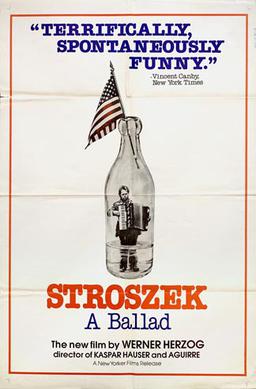
Stroszek (1977) is an odd synthesis of Werner Herzog and Raymond Carver--more like Five Easy Pieces than Nosferatu, Fitzcarraldo, or Aguirre: The Wrath of God. Herzog's movies are often about the interplay of man and nature, man and beast; though he pans his singularly ethnographic lens from Berlin to Railroad Flats, Wis., in Stroszek, this movie seems to present life as a flat line that goes from urban European dreariness to its equivalent in rural America. Grubbiness is an insuperable condition for Bruno, the depressive street musician who was abused at a Nazi reform school growing up and has been bullied ever since, and Eva, his blank-faced prostitute girlfriend. No doubt its roots are in New Hollywood at its most cynical (Five Easy Pieces, Easy Rider, Midnight Cowboy), and it probably served as inspiration for the even-more-abstract immigrant tale Stranger than Paradise, and the American indie boomlet to come. There's a strain of defeatism here that may have been tailored to the movie's star, Bruno S., but Herzog's almost stodgily objective style seems appreciative of the small pleasures of life, of music, of a premature baby that still has a chance to grow up, even of American kitsch, and the American dream on its most shoestring scale. This isn't the story of a classy European slumming in the hinterlands. The old German uncle who uses a voltage meter to measure "animal spirits" is as goofy as the American nephew who thrusts his hips in a yokel sex dance or the banker who's clearly out of his depth--he seems almost as diminutive as the pubescent agent on Louie, a show that's no doubt on the same wavelength as Herzog's sense of humor. When the expats join the nephew in his search to find a tractor (and its driver) under a frozen lake, there's something about this eccentric Calvin and Hobbes hi-jink that's as rewarding as a cup of hot coffee on a frosty day--but with that morbid undertone that makes their happiness as fragile as the ice. Sad-sack Bruno, the only member of the expatriate trio who doesn't learn English, sees the end point on the horizon before the movie does--and it almost seems like a cheat when the movie catches up to him with a vengeance. There's a barber-shop robbery as poorly conceived as any crime in a Coen Brothers movie, and a selling out of a character that seems to be excused only because Bruno is by then unhinged. The film, reportedly written in two days, is more like a short story than a feature. Bruno worries what will happen to his instruments--like his dusty piano, his "black friend"--when he croaks, and we don't know; they don't follow him to the New World. And Herzog can't hold in his bafflement about kitsch forever, so the final scene is a doozy: "We can't stop the dancing chicken," says a cop who looks to be of Pacific Northwestern Indian extraction, in regard to the livestock arcade that Bruno sets off when he reaches the literal end of his rope. They can't stop the dancing chicken. Is that his legacy? Bruno seems borderline autistic--although when people are speaking in rat-a-tat German, it's hard to tell. He's a good man who purses his lip when he talks and emotes at times with silent-film grandiosity,  but he's also a weak man--or at least a man who was irreparably broken long ago. Ian Curtis saw this film before Joy Division was to go on its American tour; he killed himself instead.

Monday, October 3, 2011

A Room with a View

Merchant-Ivory's A Room with a View (1986) is probably as "tasteful" as movies get. When its Renaissance illustrations and Florentine backdrop and Puccini on the soundtrack first broke through the Hollywood machine, louder and more starved for art than ever, it must have seemed like a godsend. Yet it can easily be shunted aside as drawing-room porn, a Masterpiece Theater afterbirth awash with "culture," but, in sum, only as challenging as Beverly Hills Cop or Top Gun. But I still found it marvelously entertaining, and here, I think, is why -- apart from such obvious factors as its wonderful cast, with wonderful elocution, in beautifully refined settings. The E. M. Forrester novel on which it was based was written in 1908, when Victorian mores were still in tact and the dark clouds of World Wars were still beyond the horizon. What was once probably considered a satire can now be seen as a straight document about exceptionally straight times; and since the strictures that keep Lucy Honeychurch from admitting her love to George Emerson are so unbelievably anachronistic, her problems seem clear-cut and simple to the point of not being problems at all. This world is both weightless and wealthy: Lucy's distress can be served up at tea or during a game of tennis on a regal estate or on an impromptu trip to Italy. And it really can be her only concern, since nobody has to work -- so it seems as if she has no concerns at all. In short, Edwardian England seems like a sort of idyll, unsullied even by seriously sexual thoughts -- all that Lucy and George do is a three-second kiss. The rest is all talk, and not even the capital-R Romance talk of Dench's novelist, because Lucy's too cool-headed. This is life on constant holiday, when it looked like happy days were there to stay.

Thursday, September 15, 2011

The Town

Ben Affleck's The Town is a movie I wanted to like more than I did. I did like it; there's no question that as a director, and as an actor, Affleck is earnest; and it's hard to not feel a certain affection for his character. But the dramatic arc goes haywire. He hardly flinches when he tries to pick up the woman he held hostage during a robbery (Rebecca Hall), and she hardly flinches when the FBI guy (Jon Hamm) tells her the truth about Affleck. He doesn't even give himself a moment to register the truth when a gangster reveals that his mother, presumed missing, was murdered. The director puts the brake on scenes too early, and plot threads simply don't tie together. The romance looms large early on, and one wants to see Hall and Affleck stay together; but Jeremy Renner, as Affleck's psychopathic accomplice, isn't a threat to their love for long. Renner is a fantastic actor when he gets to be intense and this movie gives him plenty of excuses for that. But what is one to make of this townie pscyho with a heart of gold? He has a great moment when he slurps the remainder of his drink before facing his final hail of gunfire from the FBI, but I was hoping for a little more Tommy Udo in him. He has too much "depth" when he should be simplistically frightening; and yet every other character is cardboard. Hall is stuck with the "love interest from out of town" label, and though Hamm's mannerisms are familiar, he tries to carve a prick out of his potentially dirty G-man. But Affleck is the only one with any substance, any hidden motivations. And the obstacles that require him to take on one last heist stack up too easily. Gone Baby Gone felt like the dime-novel mystery that it was, but Affleck seems to have made less with the more human material that The Town comprises. He doesn't come on as strongly with his hometown affection here, though one feels good at witnessing this love letter to a semi-anachronistic side of a city which is generally perceived in terms of wealth and history and Harvard and MIT. But the robbery scenes never go beyond average, and with the narrative ride as bumpy as it is, all one's left with is the Boston cream filling.

Thursday, September 1, 2011

The Outlaw Josey Wales

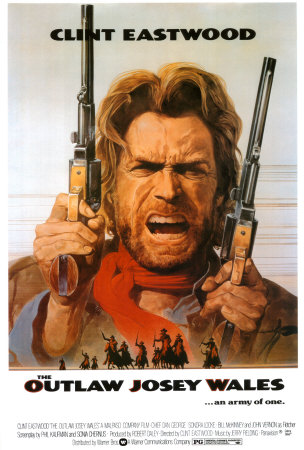
Clint Eastwood's The Outlaw Josey Wales (1976) is a compromise between the classical Western and the anti-Western, between the early Eastwood figure and his later directorial self. His early figure, despite the consistent veil of nonchalance, was actually split in two: The Man With No Name was the total mercenary, in the game only for money or survival (basically the same thing), and Dirty Harry was righteousness personified. Josey Wales hews more closely to the first. Even as the rest of his Confederate company defects at the end of the Civil War, he decides to go it on his own--not out of loyalty, and not for the cause, but mainly because he wants to be left alone. That is, he doesn't want to be the subject of any government; he identifies with dispossessed Indians and optimistic homesteaders, people who flee the constraints and trappings of civilization. In the old Westerns (like those of Ford and Hakws), Wales would've found his new home thanks to the Union Army's help; in the newer ones (like the Spaghetti Westerns or Little Big Man), he would've been implicated in making the Indians dispossessed. Here, he gets a little of both: "governments" are the killers (not just in wars, or in the way the Union guns down the surrendering Confederates, a rather garish touch. It's federal ninnies who put the bounty on Josey's head). Our hero first became bloodthirsty fighting for one government, and now he's only bloodthirsty because he's trying to get away from the other. The film has the facade of the traditional Western, but an underlying note of post-sixties anti-war/anti-authoritarian cynicism. Josey Wales is thus about "the right to be left alone": the subset of the American dream that, today, has devolved into an American delusion, but one that's forgivable when applied to the period in which this was set, when the countless factors that bind the world's population today either didn't exist or were worn thin by the vastness of the West. Even Orwell admitted that the Old West was one of the few historical frames in which men were truly free. Or was it just the inaccuracies of the Western genre that made him, and billions of others, think so? The implications of that "right" (privilege, really, but Americans love their entitlements) are often maliciously misapplied, though not in this film; Josey exercises it fairly, trading being left alone for settling down and leaving others alone. Even so, that doesn't mean that Josey Wales is not simplistic when compared to Unforgiven, which balanced its gunslinger's right to do as he pleased with that of his victims' right to survive. Josey identifies with dispossessed Indians, but black people don't seem to exist here, probably because that would mean a confrontation with historical facts, a confrontation with what Josey's army really was fighting for--and it wasn't universal liberty. The film is a sentimental fantasy, set at a time when such fantasies were permissible, and featuring a dry hero who counteracts the preachiness of a lot of Eastwood's later work. It isn't profound, but it's a beautiful Western--you wallow not just in the beauty of the setting or the beauty of the dream but in the freedom from feeling that either are affected.

Sunday, July 31, 2011

Me and You and Everyone We Know

Miranda July's Me and You and Everyone We Know (2005) is on the far side of the spectrum from snark and irony, but maybe it could use a little more of it. It's about searching for innocence -- but that can be read, by some, as lusting for regression. The worst example of this tendency occurs when the little boy gives the butch art dealer a peck on the cheek on a park bench; the kid is a like a little roving fairy that cures middle-aged malaise just by virtue of his prelapsarian youthfulness. And the art dealer is your typical cold, repressive, self-serious type -- despite the fact that she utters the best line in the movie, a full-on parody of art-world obtuseness, "If it weren't for AIDS there'd be no email!" It's out-of-nowhere lines like that that keep the movie afloat. Miranda July, as an actress, has the odd misfortune of looking too much like what she is, and she emotes insecure, sugarplum sorrow with alarming ease and frequency. Like her love interest and his older son, her eyeballs are big enough to make Bambi's look like marbles; the shoe salesman has a distractingly creepy, volatile look -- like a medieval hick (he was in "Winter's Bone") -- and yet he's got an odd twitch about the nose, like a bunny rabbit or Sam on "Bewitched." The love affair between these two, on which the movie is unevenly balanced, seems sudden and without foundation. Yet, at times, July pushes you away and then somehow wins you over: She trails the salesman as he leaves work, and wears her self-consciousness on her sleeve. You think he's going to bop her. But they tug a metaphor like taffy, and you think, This chick's got game. (At least with creeps.)

In an odd contrast with the recklessly emotive adults, the two biracial boys, and a young girl that the older boy gets acquainted with, seem almost like Children of the Damned. But the infamous "poop back-and-forth" bit is very funny (despite culminating, oh-so-cleverly, in that smooch -- which, upon reflection, is a pretty damning culmination: She can only be sexually honest with a small child tout court -- isn't it odd how much baggage comes with this quirk?), and there's something like Lynch Lite in the blowjob scene. Their weird affair with the shoe seller's coworker is, I suppose, an antithesis of the general message; he likes to think dirty thoughts about the wanna-be sluts (still really virgins, of course) but can't consummate them. But, really, I could do without those lewd messages he posts on his window: You'd think the Neighborhood Watch would have him under citizen's arrest. But Peter's relationship with the little girl -- even the 15-year-old has more innocent times to reflect on -- functions well as a parodic metaphor for the adults' questing for innocence. There are a lot of too-heavy touches of lighthearted sadness, and one wonders how well this will all age -- particularly the too-cool-for-school soundtrack, which sounds like a record needle skipping or indie marching orders -- but July's wide eyes apply to her directorial vision, too, and that informs the unreconstructed innocence of her comic gaze. It's a refined wisp of a movie with a few very memorable moments.

Monday, March 28, 2011

Mildred Pierce

Mildred Pierce (1945) starts with a callous cop accosting Mildred as she's about to leap off a bridge: an incident that sets the tone for the whole movie. Coming out the year World War II ended, this not-quite noir is an apotheosis of the Old Hollywood factory ethic, the sort of glamorous movie-star filmmaking that you're simply meant to assent to, no questions asked. But to a modern viewer, the conventions are so bald-faced that any pretense to "realism" falls by the wayside. I've seen a lot of movies from this period, but, somehow, this was one of the worst at drawing me in. Perhaps it's the pacing: There are leaps in time between scenes (probably a way of thinning out the James M. Cain source material) so characters have dramatic fallings out that must be resolved in the interstices, as they always end up back together -- always a mistake. Or maybe it's the implicit attitudes toward women (Joan Crawford can only palely imitate one, though, to be fair, she's pluming the shallow depths of movie-queen opaqueness), because Mildred seems like way too much of a chump if she's supposed to be a wildly successful restaurateur. This must be hard to do, given her company: a brassy assistant who always has some sassy, disdainful remark ready for whatever man enters the room (Eve Arden); her maid (Butterfly McQueen), who'd be a painful, walking stereotype if it wasn't for her Alvin-and-the-Chipmunks voice; her sleazo business manager (Jack Carson), whose idea of romance is demanding that she makes him a drink the minute she splits with her husband (an immediate and painless separation, mind you, that's decided upon within five minutes); her sleazo playboy boyfriend (Zachary Scott), who's a pencil-neck despite his pencil-thin mustache; and, of course, her daughter: the flashily named Veda (Ann Blyth), winner of the coldest-bitch-ever-to-appear-in-a-movie award. It's one thing for the blue-blood Scott to look down on Mildred for working for a living; it's quite another for her social-climber daughter to. (The Pierces aren't rich at the beginning, but they sure don't look poor . . . ) Their condescension is morally repugnant (and completely un-American) -- something that the filmmakers don't let you forget. But the obviousness of the delivery obscures the message. This is no mean theme for forties Hollywood, so often accused of trafficking in escapism, but the style is stultifying. (This must not have been the case for audiences of the time.) It's an unbelievable string of tawdry implausibilities, but it's all of a piece -- Crawford's imperious helplessness included -- and one admires all of its touches, down to every last shade of perfectly glimmering gray. But the movie may be worth watching simply for the gratification of seeing Mildred tear Veda's extorted $10,000 check; it's Joan's best scene because even she wants to give that snob a smack.

Friday, September 17, 2010

Le Samouraï

In Jean-Pierre Melville’s Le Samouraï (1967), Alain Delon is like Michael Corleone at the end of the first Godfather. He’s dead-eyed and withdrawn; he lives to accomplish objectives that he spares nary a thought about; his girlfriend is an accessory, nothing more. Or is she? Although this is often called a great film, and Melville’s best—Army of Shadows, which features one of the most heart-rending executions in movie history, is a bona fide masterpiece—I don’t think it’s quite in the pantheon, or was meant to be. We see how Michael’s heart went cold; Le Samouraï is not—to borrow from Louis Malle’s The Fire Within—about a man with a heart to lose, but a brute force of nature. The title led me to expect an honorable killer, like Vito Corleone. The preface is from the book of Bushido: “There is no greater solitude than that of the samurai, unless it is that of the tiger of the jungle, perhaps.” The title should have been Le Tigre. But there’s more than one keyword in there, and they’re related. Delon lives in a scummy, unadorned flat. He’s not a disillusioned drinker like his film noir antecedents: He orders a whiskey and leaves it at the bar, and his apartment is stocked with Perriers. Only Perriers. “Solitude” implies an introspection that Delon lacks, but then there’s that tricky “perhaps.” That ties into his relationship with his girl (Nathalie Delon), who seems to think he needs her. And it ties into his relationship with the pianist (Caty Rosier); we’re never sure of her motives. Even if the story seems extremely basic, and Delon seems like a rather paltry assassin—from what we see of his methods, he should’ve been behind bars a long time ago—Melville doesn’t give us quite enough to know what’s going on, and that adds to the tension. Rosier gives him a look, a slight variant of her polite, professional-musician smile; is she an accomplice? Their relationship is ambiguous in a way that Delon’s personality is not. He’s impenetrable because he’s a genre construct, an existential given—and nobody underplays as stylishly as Delon. The mystery of his origins seems artificial, and that’s why the film never transcends its genre, as Army of Shadows and The Godfather do. But, as a thriller—as a commercial film rather than a work of art—it’s top notch, on par with something like the American Kiss of Death. It’s a French French Connection, with all the scrappy vigor of the New Wave. Delon may not be a samurai, but Melville cuts like one; like the swordsman in The Seven Samurai, it’s hard not admire his graceful craft.

Friday, September 10, 2010

Two-Lane Blacktop

Monte Hellman’s Two-Lane Blacktop (1971) has a cool, distinctive vision of America that’s both post-hippie and pre-counterculture; the young anti-heroes, though two are played by musicians, seem rather apathetic to drugs and rock’n’roll. James Taylor and Laurie Bird share sexual vibes, but this love ain’t free—though, for the hitchhiking teenager Bird, love often appears to be. For the mechanic, played by Beach Boy Dennis Wilson, life only seems to exist beneath a car’s hood. Then there’s Warren Oates, the rambler in his G.T.O., who seems snowed in by his life experiences (he has lived twice as long as the others); he has the most human dimensions, but seems like a mythological shape-shifter: He’s so uncomfortable with himself that he puts on a smile and tells a new lie to every hitcher he picks up. Being an itinerant isn’t really a choice for him. When he picks up Harry Dean Stanton—whose voice warbles like Hank Williams’s, in piteous tones—and Stanton caresses G.T.O.’s leg, Oates shouts (hilariously!), “I’m not into that!” When Oates picks up a mustachioed hippie, who implies that a mysterious “we” have only thirty, forty years left (it being 2010 puts “us” in trouble), this pessimism makes Oates crumble; it rattles his phony enthusiasm and hits him too close to home. Nobody in this picture has a past or future; and since they keep on trucking, nobody really has a present, either. The “road” is a cheesy metaphor—even Hellman, in a D.V.D. feature, hates to “acknowledge the existential stigma this movie has to it”—but it’s a beaut here. Route 66—now an icon for nostalgists—is the road they’re taking cross-country, and if that’s not a bad omen, what is?

While seconding Hellman’s reluctance to broach existentialism—though, in a way, it’s there, just as it’s present in so much else—I think this film compares to
Hiroshima, Mon Amour, Alain Resnais’s beautiful avant-garde poem of about a dozen years earlier. The stories are completely different, and so are the narrative techniques, but they both hit on that lack of a present timeframe. In the French film, time is garbled by flashbacks to emotions that still feel fresh; here, we haven’t anything to flash back to. It’s about the perils of living in the moment. Blacktop came out the same year that Hunter Thompson wrote about the wave of youth and freedom cresting in Fear and Loathing in Las Vegas. The counterculture’s awareness of its own demise is palpable, almost bitter, here—in a way that it wasn’t in the euphoric Bonnie and Clyde, four years earlier. (Some critics compared this film to the recent George Clooney vehicle The American, but despite the drag-racing, Blacktop exists on its own—without pulp. The American wraps its “art” not around something that’s dying, but something that’s always been, aesthetically speaking, dead.) But, to look back on Blacktop from this vantage—writing on a laptop, publishing on the internet, driving on long, anonymous freeways from which every town looks the same—there’s enough long hair to make one feel nostalgic. We’re witnessing a moment the filmmakers already thought was gone.