 In Jean-Pierre Melville’s Le Samouraï (1967), Alain Delon is like Michael Corleone at the end of the first Godfather. He’s dead-eyed and withdrawn; he lives to accomplish objectives that he spares nary a thought about; his girlfriend is an accessory, nothing more. Or is she? Although this is often called a great film, and Melville’s best—Army of Shadows, which features one of the most heart-rending executions in movie history, is a bona fide masterpiece—I don’t think it’s quite in the pantheon, or was meant to be. We see how Michael’s heart went cold; Le Samouraï is not—to borrow from Louis Malle’s The Fire Within—about a man with a heart to lose, but a brute force of nature. The title led me to expect an honorable killer, like Vito Corleone. The preface is from the book of Bushido: “There is no greater solitude than that of the samurai, unless it is that of the tiger of the jungle, perhaps.” The title should have been Le Tigre. But there’s more than one keyword in there, and they’re related. Delon lives in a scummy, unadorned flat. He’s not a disillusioned drinker like his film noir antecedents: He orders a whiskey and leaves it at the bar, and his apartment is stocked with Perriers. Only Perriers. “Solitude” implies an introspection that Delon lacks, but then there’s that tricky “perhaps.” That ties into his relationship with his girl (Nathalie Delon), who seems to think he needs her. And it ties into his relationship with the pianist (Caty Rosier); we’re never sure of her motives. Even if the story seems extremely basic, and Delon seems like a rather paltry assassin—from what we see of his methods, he should’ve been behind bars a long time ago—Melville doesn’t give us quite enough to know what’s going on, and that adds to the tension. Rosier gives him a look, a slight variant of her polite, professional-musician smile; is she an accomplice? Their relationship is ambiguous in a way that Delon’s personality is not. He’s impenetrable because he’s a genre construct, an existential given—and nobody underplays as stylishly as Delon. The mystery of his origins seems artificial, and that’s why the film never transcends its genre, as Army of Shadows and The Godfather do. But, as a thriller—as a commercial film rather than a work of art—it’s top notch, on par with something like the American Kiss of Death. It’s a French French Connection, with all the scrappy vigor of the New Wave. Delon may not be a samurai, but Melville cuts like one; like the swordsman in The Seven Samurai, it’s hard not admire his graceful craft.
Friday, September 17, 2010
Le Samouraï
In Jean-Pierre Melville’s Le Samouraï (1967), Alain Delon is like Michael Corleone at the end of the first Godfather. He’s dead-eyed and withdrawn; he lives to accomplish objectives that he spares nary a thought about; his girlfriend is an accessory, nothing more. Or is she? Although this is often called a great film, and Melville’s best—Army of Shadows, which features one of the most heart-rending executions in movie history, is a bona fide masterpiece—I don’t think it’s quite in the pantheon, or was meant to be. We see how Michael’s heart went cold; Le Samouraï is not—to borrow from Louis Malle’s The Fire Within—about a man with a heart to lose, but a brute force of nature. The title led me to expect an honorable killer, like Vito Corleone. The preface is from the book of Bushido: “There is no greater solitude than that of the samurai, unless it is that of the tiger of the jungle, perhaps.” The title should have been Le Tigre. But there’s more than one keyword in there, and they’re related. Delon lives in a scummy, unadorned flat. He’s not a disillusioned drinker like his film noir antecedents: He orders a whiskey and leaves it at the bar, and his apartment is stocked with Perriers. Only Perriers. “Solitude” implies an introspection that Delon lacks, but then there’s that tricky “perhaps.” That ties into his relationship with his girl (Nathalie Delon), who seems to think he needs her. And it ties into his relationship with the pianist (Caty Rosier); we’re never sure of her motives. Even if the story seems extremely basic, and Delon seems like a rather paltry assassin—from what we see of his methods, he should’ve been behind bars a long time ago—Melville doesn’t give us quite enough to know what’s going on, and that adds to the tension. Rosier gives him a look, a slight variant of her polite, professional-musician smile; is she an accomplice? Their relationship is ambiguous in a way that Delon’s personality is not. He’s impenetrable because he’s a genre construct, an existential given—and nobody underplays as stylishly as Delon. The mystery of his origins seems artificial, and that’s why the film never transcends its genre, as Army of Shadows and The Godfather do. But, as a thriller—as a commercial film rather than a work of art—it’s top notch, on par with something like the American Kiss of Death. It’s a French French Connection, with all the scrappy vigor of the New Wave. Delon may not be a samurai, but Melville cuts like one; like the swordsman in The Seven Samurai, it’s hard not admire his graceful craft.

Friday, September 10, 2010
Two-Lane Blacktop
 Monte Hellman’s Two-Lane Blacktop (1971) has a cool, distinctive vision of America that’s both post-hippie and pre-counterculture; the young anti-heroes, though two are played by musicians, seem rather apathetic to drugs and rock’n’roll. James Taylor and Laurie Bird share sexual vibes, but this love ain’t free—though, for the hitchhiking teenager Bird, love often appears to be. For the mechanic, played by Beach Boy Dennis Wilson, life only seems to exist beneath a car’s hood. Then there’s Warren Oates, the rambler in his G.T.O., who seems snowed in by his life experiences (he has lived twice as long as the others); he has the most human dimensions, but seems like a mythological shape-shifter: He’s so uncomfortable with himself that he puts on a smile and tells a new lie to every hitcher he picks up. Being an itinerant isn’t really a choice for him. When he picks up Harry Dean Stanton—whose voice warbles like Hank Williams’s, in piteous tones—and Stanton caresses G.T.O.’s leg, Oates shouts (hilariously!), “I’m not into that!” When Oates picks up a mustachioed hippie, who implies that a mysterious “we” have only thirty, forty years left (it being 2010 puts “us” in trouble), this pessimism makes Oates crumble; it rattles his phony enthusiasm and hits him too close to home. Nobody in this picture has a past or future; and since they keep on trucking, nobody really has a present, either. The “road” is a cheesy metaphor—even Hellman, in a D.V.D. feature, hates to “acknowledge the existential stigma this movie has to it”—but it’s a beaut here. Route 66—now an icon for nostalgists—is the road they’re taking cross-country, and if that’s not a bad omen, what is?
While seconding Hellman’s reluctance to broach existentialism—though, in a way, it’s there, just as it’s present in so much else—I think this film compares to Hiroshima, Mon Amour, Alain Resnais’s beautiful avant-garde poem of about a dozen years earlier. The stories are completely different, and so are the narrative techniques, but they both hit on that lack of a present timeframe. In the French film, time is garbled by flashbacks to emotions that still feel fresh; here, we haven’t anything to flash back to. It’s about the perils of living in the moment. Blacktop came out the same year that Hunter Thompson wrote about the wave of youth and freedom cresting in Fear and Loathing in Las Vegas. The counterculture’s awareness of its own demise is palpable, almost bitter, here—in a way that it wasn’t in the euphoric Bonnie and Clyde, four years earlier. (Some critics compared this film to the recent George Clooney vehicle The American, but despite the drag-racing, Blacktop exists on its own—without pulp. The American wraps its “art” not around something that’s dying, but something that’s always been, aesthetically speaking, dead.) But, to look back on Blacktop from this vantage—writing on a laptop, publishing on the internet, driving on long, anonymous freeways from which every town looks the same—there’s enough long hair to make one feel nostalgic. We’re witnessing a moment the filmmakers already thought was gone.
Monday, September 6, 2010
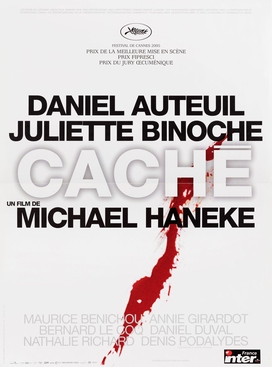
Caché
Subscribe to:
Posts (Atom)